
Water is often the reason a retaining wall fails long before the wall itself looks damaged. After a hard Maryland rain, moisture can collect behind the wall, saturate the soil, and create pressure that pushes outward with surprising force. The right retaining wall drainage solutions move that water safely away before it compromises the wall, the landscape, or nearby paved surfaces.
A retaining wall should do more than hold back a slope. It should protect the usable space around it, whether that means a backyard patio, a driveway edge, a commercial landscape bed, or a parking-area grade change. Drainage is what allows that wall to perform reliably through repeated rain, freezing temperatures, and seasonal ground movement.
Why Water Pressure Is a Retaining Wall Problem
Soil changes when it gets wet. Dry soil has weight, but saturated soil holds additional water and becomes significantly heavier. Water also fills the tiny gaps between soil particles, creating hydrostatic pressure against the back of the wall. A well-built wall can still be put under stress when that pressure has nowhere to go.
The first warning signs are not always dramatic. You may see damp streaks on the wall face, soil washing out near the top, standing water behind the wall, or sections that begin to lean, bow, or separate. In more advanced cases, the wall can shift enough to affect adjacent walkways, patios, driveways, and landscaping.
Drainage is not an optional finishing detail. It is part of the wall system from the base upward. A thoughtful plan keeps water from building up behind the structure while helping the surrounding ground remain stable.
Retaining Wall Drainage Solutions That Work Together
Effective drainage usually depends on several components working as one system. The right combination depends on wall height, site slope, soil conditions, the amount of runoff, and what sits above and below the wall.
Free-Draining Stone Backfill
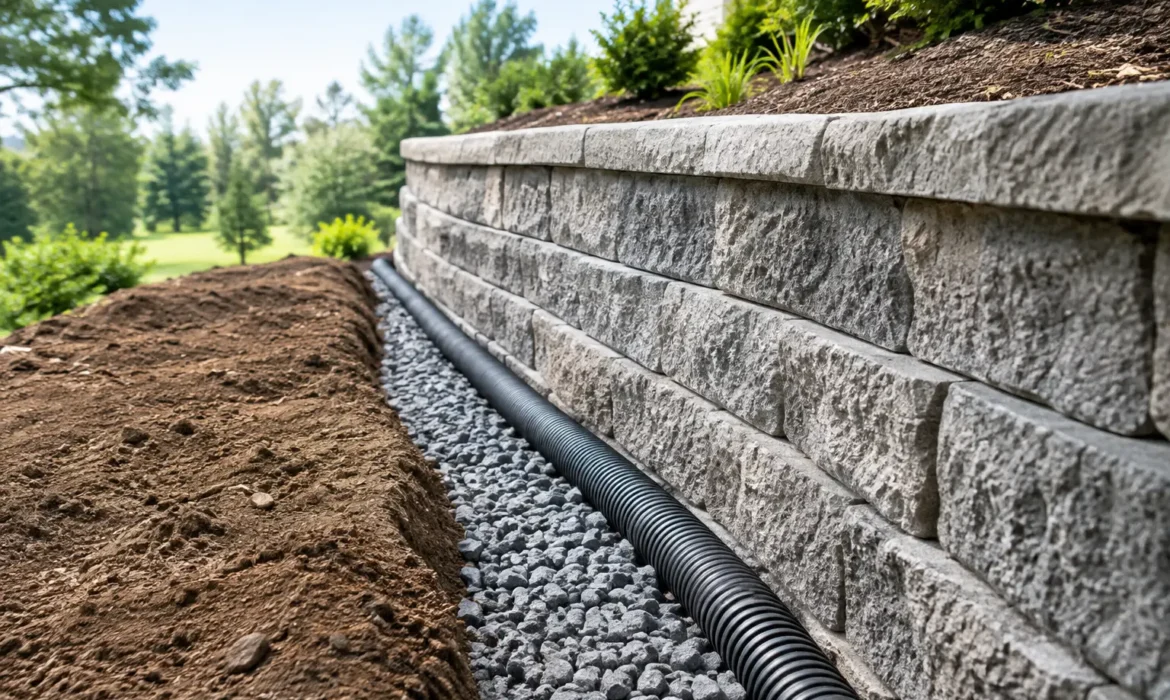
The material immediately behind a retaining wall matters as much as the visible wall face. Clean drainage stone leaves open spaces for water to travel downward instead of trapping moisture against the structure. This is a major improvement over placing dense native soil directly behind the wall.
Stone backfill also helps reduce the pressure created by saturated soil. It supports consistent drainage toward the collection pipe at the bottom of the wall and creates a more stable zone behind the structure. The stone must be installed to the proper depth and compacted carefully. Poor compaction can create settling that affects both drainage and appearance.
Perforated Drain Pipe at the Base
A perforated drain pipe, often called a footing drain, is installed near the base behind the wall. Its job is to collect water that moves through the stone and carry it to a safe discharge point. Without it, water may reach the bottom of the wall but remain trapped in the drainage zone.
Pipe placement and slope are essential. A pipe that is crushed, flat, clogged, or directed toward an area where water can pool will not solve the problem. The outlet also needs to be planned around the property’s grade so discharged water does not create erosion or flooding elsewhere.
Filter Fabric to Keep Soil Out
Filter fabric separates the drainage stone from surrounding soil. It allows water through while helping prevent fine soil particles from washing into the stone and pipe. This is especially valuable where the native soil contains clay or other fine material that can migrate into the drainage system over time.
Without separation, the voids in the stone can slowly fill with sediment. The wall may look fine for years while its drainage performance steadily declines. Proper fabric placement is a small part of the installation, but it has a meaningful effect on long-term function.
Surface Grading Above the Wall
Water should not be allowed to pour directly toward the back of a retaining wall. The finished grade above the wall should guide rainfall away from the edge where practical. Swales, landscape shaping, and properly placed collection points can reduce the volume of water entering the wall’s backfill area.
This is particularly important when a roof downspout, driveway, patio, or neighboring slope sends runoff toward the wall. A wall drainage system can handle normal moisture, but it should not be expected to manage every source of concentrated runoff without proper site planning.
Drainage Openings When Appropriate
Some wall designs include drainage openings that allow water to escape through the face of the wall. These can be useful on certain structures, particularly when a wall has a solid face and a controlled outlet is needed. They are not the right answer for every installation, however.
Openings need to remain clear and should be positioned so water leaves without staining surfaces or eroding the area below. For many walls, a stone backfill and base drain provide the primary drainage path, while face openings serve as an added release point.
Start With the Site, Not a Standard Detail
There is no one-size-fits-all drainage layout. A short landscape wall on a gently sloped yard does not face the same forces as a taller wall supporting a driveway, commercial entrance, or elevated outdoor area. The best approach starts with an assessment of how water already moves across the property.
Look at where water stands after rain, where gutters discharge, and whether nearby hard surfaces direct runoff toward the wall. Consider the soil as well. Maryland properties often have dense soils that drain slowly, making a carefully designed stone and pipe system more valuable than a basic installation.
The wall’s purpose also changes the construction approach. A decorative garden wall may require a modest drainage system, while a wall supporting vehicle areas or substantial grade changes needs deeper attention to base preparation, reinforcement, drainage capacity, and outlet location. The visible finish may differ, but the water-management principles remain the same.
Common Drainage Mistakes That Shorten Wall Life
The most expensive drainage problems are often hidden behind an otherwise attractive wall. Installing a wall with soil directly against the back, skipping the base drain, or using the wrong backfill material can trap moisture from the first significant storm.
Another common mistake is allowing downspouts to empty behind or beside the wall. That concentrated flow can overwhelm the stone backfill, carry soil with it, and erode the area around the structure. Redirecting roof runoff is often a straightforward way to protect the wall and the landscape around it.
Drainage outlets also deserve attention. Water must have a clear path to leave the system. If the outlet becomes buried, blocked by mulch, or aimed at a low spot, the pipe can back up and the wall will again hold water where it should not.
Finally, avoid treating visible cracks or leaning as cosmetic issues. A wall that is moving may be signaling a drainage or base problem beneath the surface. Addressing the source early is usually more practical than waiting for a section to require reconstruction.
Protect Nearby Paving, Patios, and Walkways
Retaining-wall drainage does not exist in isolation. When water moves incorrectly around a wall, it can undermine nearby concrete, wash material from beneath pavers, soften asphalt edges, and create uneven walking surfaces. These issues are especially frustrating when a property owner has invested in an improved driveway, patio, or business entrance.
A coordinated exterior project considers the relationship between grades, retaining walls, hardscapes, and drainage from the beginning. The goal is to create a finished space where water has an intended path instead of finding its own route beneath or around the work.
For commercial properties, proper drainage also supports a cleaner, more dependable appearance at entrances, landscaped islands, and parking areas. For homeowners, it helps preserve outdoor living areas and reduces the risk of muddy, eroded spaces after storms.
When to Call a Professional
If a retaining wall is leaning, cracking, bulging, showing persistent dampness, or surrounded by erosion, a professional evaluation is a smart next step. The issue may be limited to surface drainage, but it can also involve concealed backfill, pipe, base, or grading concerns that require a more complete repair plan.
New wall projects benefit from the same early attention. A contractor can evaluate the site, identify likely water paths, and build drainage into the work rather than trying to add it after the wall is complete. All Star Contracting Services helps Maryland property owners approach retaining walls as durable site improvements, with drainage and finished appearance considered together.
The best time to solve water problems is before the next heavy rain tests the wall. A properly planned drainage system gives the water somewhere to go and gives your retaining wall the support it needs to remain straight, stable, and attractive for years.