
Water should leave a driveway without leaving evidence behind. If you see puddles near the garage, water crossing a walkway, washed-out gravel, or dark moisture stains along the foundation, the surface is not directing runoff where it needs to go. Knowing how to improve driveway drainage can protect the pavement, improve daily access, and help prevent water from creating larger property problems over time.
For Maryland homes and commercial properties, drainage needs to handle steady rain, sudden downpours, winter freeze-thaw cycles, and the runoff created by sloped lots. The right fix is rarely just one product or one patch. It begins with understanding where the water starts, where it travels, and where it can safely discharge.
How to Improve Driveway Drainage at the Source
The most reliable drainage improvements start with the driveway’s shape. Asphalt, concrete, pavers, and gravel all need a planned slope so water moves off the surface instead of settling in low areas. A driveway can look level from the street and still hold enough water to cause deterioration, especially at the garage entrance, along a curb line, or where a drive meets a parking area.
Walk the property shortly after a hard rain. Follow the water from high ground toward the driveway and note where it collects. Pay close attention to roof downspouts, neighboring grades, landscape beds, retaining walls, and the transition between the driveway and garage. These features often send water toward the pavement even when the driveway itself appears to be in good condition.
A drainage plan should also identify a suitable discharge area. The goal is to move water away from buildings, drive lanes, and pedestrian areas without simply sending the problem to another part of the property. On a residential lot, that may mean directing runoff toward an appropriate landscaped area. On a commercial site, it may involve coordinating surface grades across parking stalls, entrances, and surrounding pavement.
Correct the Surface Grade
Regrading is often the best answer when standing water is widespread or the driveway slopes toward a structure. A contractor can reshape the base and finished surface so water flows consistently toward the intended edge or collection point. This is more effective than repeatedly filling depressions, because a patch alone may not correct the underlying grade.
For asphalt driveways, low spots can sometimes be addressed with leveling work and a properly installed overlay. If the pavement has widespread cracking, soft areas, or base failure, removal and reconstruction may be the longer-lasting choice. Water that penetrates cracks can weaken the material below the surface, so drainage and pavement repair should be planned together.
Concrete requires the same attention to slope, but its drainage corrections are less forgiving once the slab is in place. Small problem areas may be repaired selectively. Larger drainage failures may call for removing and replacing sections so the finished surface performs as intended.
Match the Drainage Solution to the Problem
Not every wet driveway needs a complete rebuild. The best approach depends on the source of the water, the amount of runoff, the driveway material, and the layout of the property. A professional site assessment helps separate a surface issue from a broader grading issue.
Install a Channel Drain Where Water Crosses the Driveway
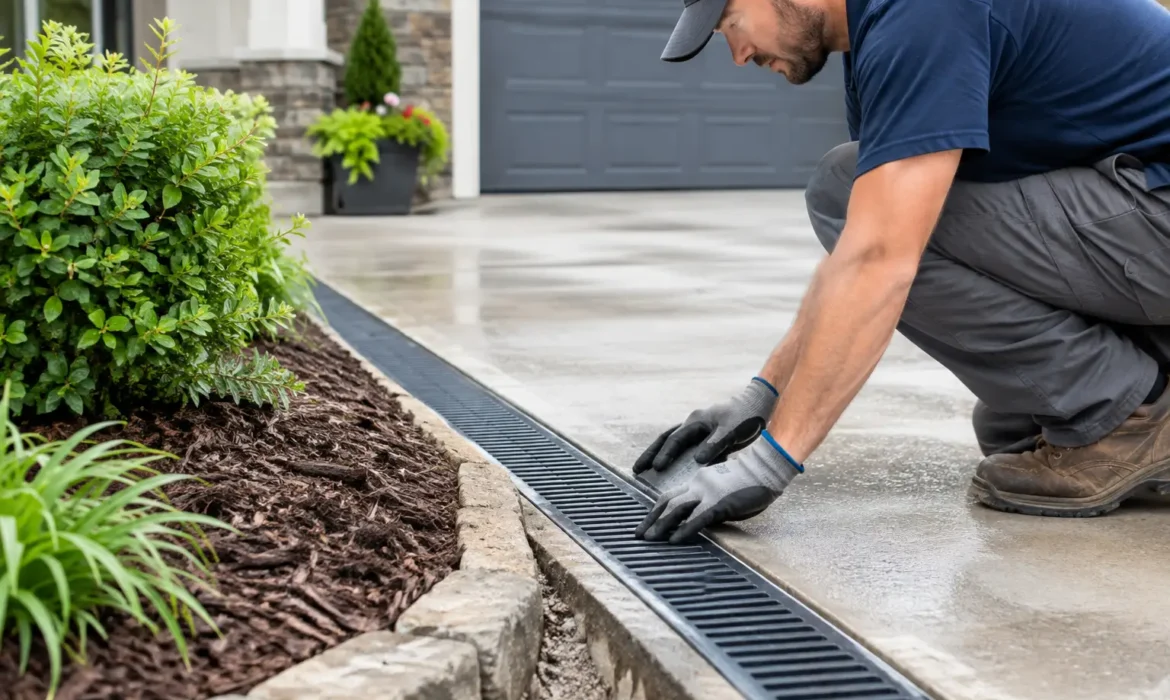
A channel drain is useful when runoff travels across a driveway and needs to be intercepted before reaching a garage, entryway, lower parking area, or sidewalk. Installed across the path of water, it collects runoff through a grated opening and carries it away through an underground outlet.
This approach is especially effective at the bottom of a sloped driveway or directly in front of a garage where water has nowhere else to go. The drain must be set at the right elevation and tied into a reliable discharge path. If it is installed too high, too low, or without enough outlet capacity, water can continue to pond around it.
Use Swales and Landscape Grading for Gentle Runoff
A swale is a shallow, shaped channel that guides water through a landscape area. It can be a practical option when there is room beside the driveway and the runoff does not need an enclosed drain system. With careful grading, a swale can move water away from pavement while blending into the property more naturally than a visible concrete channel.
This option works best when the landscape has enough space and the soil can manage the expected runoff. It may not be the right fit beside a narrow urban driveway or a busy commercial entrance, where vehicles and foot traffic limit available space.
Add Drainage Stone Along the Driveway Edge
Drainage stone can help manage water along the sides of a driveway, particularly where the pavement edge meets a lawn or planting bed. A properly built stone trench can reduce saturation around the base and give runoff a path away from the surface.
This is not a substitute for correcting a driveway that is pitched toward a building. It is better suited for edge drainage, minor runoff, or areas where water softens the shoulder and causes the pavement to crack or crumble. The stone needs separation from surrounding soil and adequate depth to keep it from filling with sediment quickly.
Redirect Roof Runoff Before It Reaches Pavement
Downspouts can deliver a surprising amount of water directly onto a driveway. If roof runoff lands near the garage, at the top of a slope, or beside an asphalt edge, it can create the same recurring wet spot after every storm.
Extending or redirecting downspout discharge away from the driveway may reduce the load on the pavement significantly. This simple change is most effective when paired with proper ground grading. Otherwise, the water may still travel back toward the drive once it reaches the yard.
Protect the Driveway Base, Not Just the Surface
The visible surface is only part of a driveway’s drainage system. Beneath asphalt or concrete is a prepared base that supports traffic and helps the surface remain stable. When water reaches that base repeatedly, it can soften the ground, create voids, and lead to cracking, settlement, potholes, or broken edges.
That is why a durable drainage repair often requires excavation rather than a surface-only fix. If the base has failed, the damaged material may need to be removed, replaced, compacted, and graded before new pavement is installed. This work takes more planning, but it addresses the condition causing the visible damage.
For gravel driveways, base stability is equally important. Fresh gravel placed over soft, saturated ground may look better briefly but can rut and wash away with the next heavy rain. Rebuilding the driveway profile and establishing drainage paths will produce a more dependable result.
Maintain Drainage Features Through the Seasons
A well-designed system still needs routine attention. Leaves, mulch, sediment, and debris can block drain grates and shallow swales. Asphalt cracks can widen, allowing more water into the base. A settled shoulder can trap water along the pavement edge instead of letting it drain away.
Inspect the driveway after major storms and at the start of spring. Clear visible debris from collection points, look for new ponding, and watch for changes in surface color or texture. On asphalt, timely crack repair and sealcoating can help limit water intrusion, but maintenance works best when the driveway already has proper drainage.
Commercial properties should also watch high-traffic areas closely. Delivery lanes, parking entrances, and dumpster areas often experience concentrated vehicle weight and runoff. Addressing early signs of settlement can prevent a smaller drainage concern from becoming a larger pavement repair.
When a Professional Evaluation Makes Sense
Call for a driveway drainage evaluation when water reaches a garage or building, pools for more than a day after rain, repeatedly freezes on driving or walking surfaces, or causes cracking and sinking in the pavement. These signs often point to a grading or base issue that will not improve with temporary patching.
A qualified contractor can evaluate the entire site rather than treating the puddle alone. That includes the driveway slope, surrounding grades, pavement condition, runoff sources, and practical options for collecting or redirecting water. The right recommendation should balance drainage performance, vehicle use, appearance, and the long-term condition of the surface.
A dry driveway is not just cleaner after a storm. It is easier to use, safer underfoot, and better positioned to deliver the durable curb appeal your property deserves. Start with the water’s path, then choose improvements that solve the cause rather than covering the symptom.