
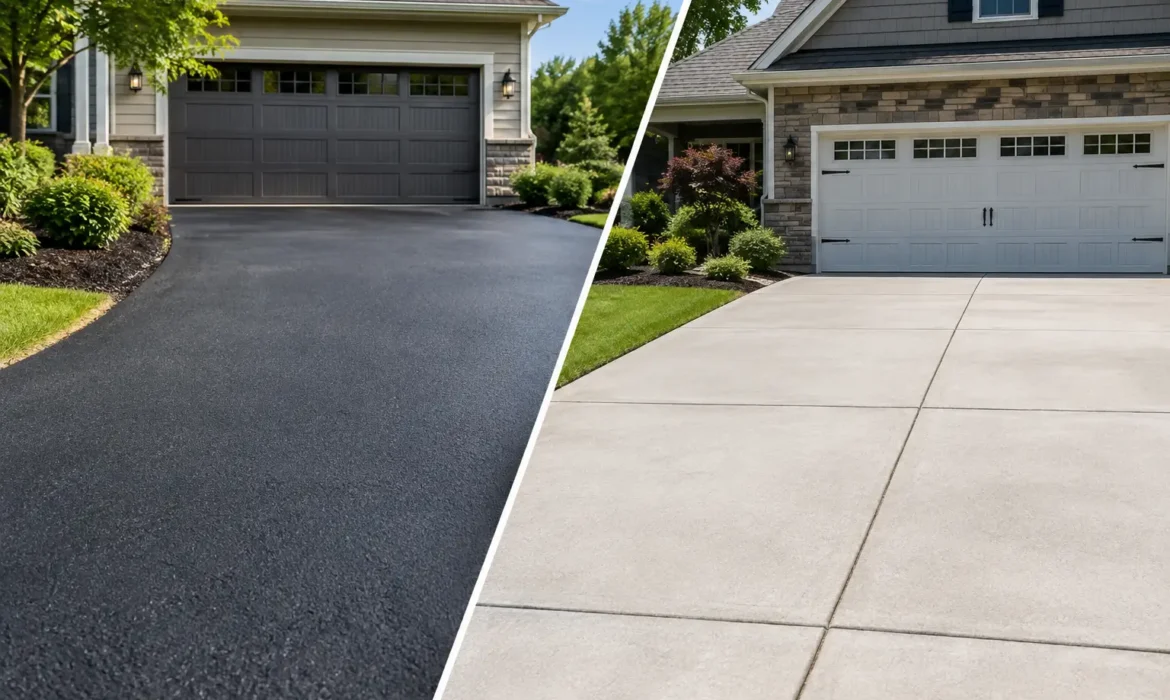
A driveway has to do more than look good on move-in day. It needs to carry daily vehicle traffic, shed water, handle freeze-thaw cycles, and complement the property for years. When comparing asphalt vs concrete driveways, Maryland property owners are usually weighing a lower initial investment and flexible surface against a longer-lasting, more customizable finish. The right choice depends on the site, expected use, budget, and willingness to keep up with maintenance.
Asphalt vs Concrete Driveways: The Core Difference
Asphalt is a flexible paving material made from aggregate and petroleum-based binder. It is installed hot, compacted into place, and typically ready for careful use relatively quickly. Its dark, uniform appearance works well with many homes, commercial entrances, and practical high-traffic areas.
Concrete is a rigid slab made from cement, water, sand, and stone. It can be finished in a straightforward gray surface or enhanced with color, stamping, borders, exposed aggregate, and other decorative treatments. Once cured properly, concrete provides a clean, substantial appearance that many homeowners associate with long-term value.
Neither material is automatically better. A well-installed driveway begins with proper grading, drainage planning, excavation, and a stable base. Poor preparation can shorten the life of either asphalt or concrete, regardless of the material selected.
Initial Cost and Long-Term Value
For many Maryland homeowners, asphalt is the more budget-friendly choice at installation. It generally requires less upfront investment than a comparable concrete driveway, particularly for larger driveways or properties with long private access lanes. That can make asphalt an efficient solution when a driveway needs replacement without delaying other exterior improvements.
Concrete often costs more at the outset, especially when the project includes decorative finishes, thicker sections for heavier vehicles, or complex layout work. However, a properly built concrete driveway may provide a longer service life before full replacement is needed. The trade-off is that when concrete does develop significant cracking, settlement, or surface damage, repairs can be more noticeable and more involved.
Value should not be measured by installation price alone. Consider the expected time in the property, the driveway’s role in curb appeal, vehicle loads, maintenance expectations, and whether the surface is part of a larger improvement plan involving walkways, patios, retaining walls, or drainage corrections.
Maryland Weather and Freeze-Thaw Performance
Maryland weather asks a lot of exterior surfaces. Winter temperatures can move above and below freezing in short cycles, while spring rain, summer heat, and occasional snow or ice add further stress. Water is often the central issue. When it enters cracks, joints, or weak spots in the base and then freezes, expansion can cause damage to grow.
Asphalt’s flexibility is one of its strongest advantages in a changing climate. It can move slightly with temperature shifts and minor ground movement without cracking as readily as a rigid slab. Its black surface also absorbs heat, which can help snow and ice melt faster on sunny winter days.
Concrete performs well in Maryland when it is designed and installed for local conditions. Proper thickness, control joints, drainage, and a sound compacted base all matter. Deicing chemicals require care, particularly during concrete’s early life, because harsh products can contribute to surface scaling. Property owners should use products appropriate for concrete and avoid relying on rock salt when possible.
Maintenance Requirements Are Different
Asphalt requires more routine attention, but much of that maintenance is straightforward. Sealcoating on an appropriate schedule helps protect the surface from oxidation, moisture, automotive fluids, and fading. Small cracks should be addressed early before water reaches the base beneath the pavement.
A new asphalt driveway should be allowed to cure before sealcoating, following contractor guidance. After that, a maintenance plan can significantly improve the surface’s appearance and extend its useful life. Avoid parking heavy equipment in one place for extended periods, especially during hot weather when newer asphalt may be softer.
Concrete does not need sealcoating in the same way asphalt does, although it benefits from periodic sealing to help resist staining, moisture intrusion, and surface wear. The biggest maintenance concern is preventing small issues from becoming structural ones. Keep joints clear, manage drainage, remove stains promptly, and repair cracking before it expands or allows water beneath the slab.
Concrete’s lighter color can show tire marks, oil spots, and rust stains more readily than asphalt. Asphalt hides many stains better, but its surface will gradually fade from deep black to gray without sealcoating.
Appearance and Curb Appeal
Concrete gives homeowners more visual design options. A broom finish offers a clean, slip-resistant surface, while stamped concrete can create the look of stone, brick, or pavers. Color, borders, and coordinated walkways can make a driveway feel like an intentional part of the home’s exterior design rather than just a place to park.
Asphalt offers a crisp, classic appearance that suits both traditional and modern homes. Freshly paved asphalt has a rich black finish that creates strong contrast with landscaping, masonry, and light-colored siding. It is also easy to achieve smooth transitions from a driveway to a parking area or private road.
For commercial properties, appearance is closely tied to safety and customer perception. A smooth asphalt parking area can support efficient striping, traffic flow, and maintenance. Concrete is often well suited for entrances, loading areas, curbs, sidewalks, ADA ramps, and locations where a more permanent architectural finish is desired.
Traffic, Site Conditions, and Drainage
The vehicles using the driveway should influence the material and design. A typical household with passenger vehicles has different needs than a property with delivery trucks, trailers, recreational vehicles, or frequent heavy equipment. Concrete may be a strong choice for areas exposed to concentrated weight, while asphalt can be designed with appropriate thickness and base preparation for heavier traffic as well.
Site conditions matter just as much. If a driveway has low spots, poor drainage, soft subgrade, tree-root concerns, or visible settlement, the underlying issue should be addressed before new paving begins. Installing a new surface over a failing base may create a temporary visual improvement, but it will not correct the cause of cracking, rutting, or water pooling.
A professional assessment should consider the driveway’s slope, runoff direction, existing pavement condition, garage or street transitions, and drainage features. In some cases, the best plan combines materials, such as an asphalt drive with concrete apron sections, walkways, or decorative patio areas.
When Asphalt Is Often the Better Fit
Asphalt is often a practical fit for property owners who want a cost-effective driveway, need a large area paved, or prefer a surface that performs well through seasonal movement. It is also a strong option when a driveway needs resurfacing or replacement on a disciplined timeline.
Its maintenance needs are predictable, and sealcoating can renew the appearance of a weathered surface. For commercial lots and long residential drives, asphalt can provide a durable, professional result without pushing the entire project budget into the surface alone.
When Concrete Is Often the Better Fit
Concrete is often the right choice for homeowners prioritizing a customized appearance, a light-colored surface, or an investment intended to remain in place for decades with attentive care. It is especially appealing where the driveway connects to concrete sidewalks, front steps, patios, or other hardscape features.
It can also be an excellent choice for areas requiring a firm, defined surface, provided the slab is engineered for the anticipated loads and installed on a properly prepared base. Decorative concrete can elevate the entrance of a home or business while maintaining the strength needed for daily use.
Make the Decision With the Whole Property in Mind
The best driveway material is the one that matches the conditions beneath it and the way the property is used. A lower initial asphalt price may be the sensible decision for one home, while concrete’s appearance and longevity may justify its added investment for another. The quality of installation remains the deciding factor in either case.
Before choosing, ask for a clear scope that addresses excavation, base preparation, thickness, drainage, edges, joints, curing, and future maintenance. An experienced contractor should explain why a recommendation fits the site instead of simply steering every project toward one material.
All Star Contracting Services helps Maryland property owners evaluate those details with a practical, project-specific approach. A careful on-site estimate can turn a driveway decision into a durable improvement that looks right, drains properly, and supports the property for years ahead.