
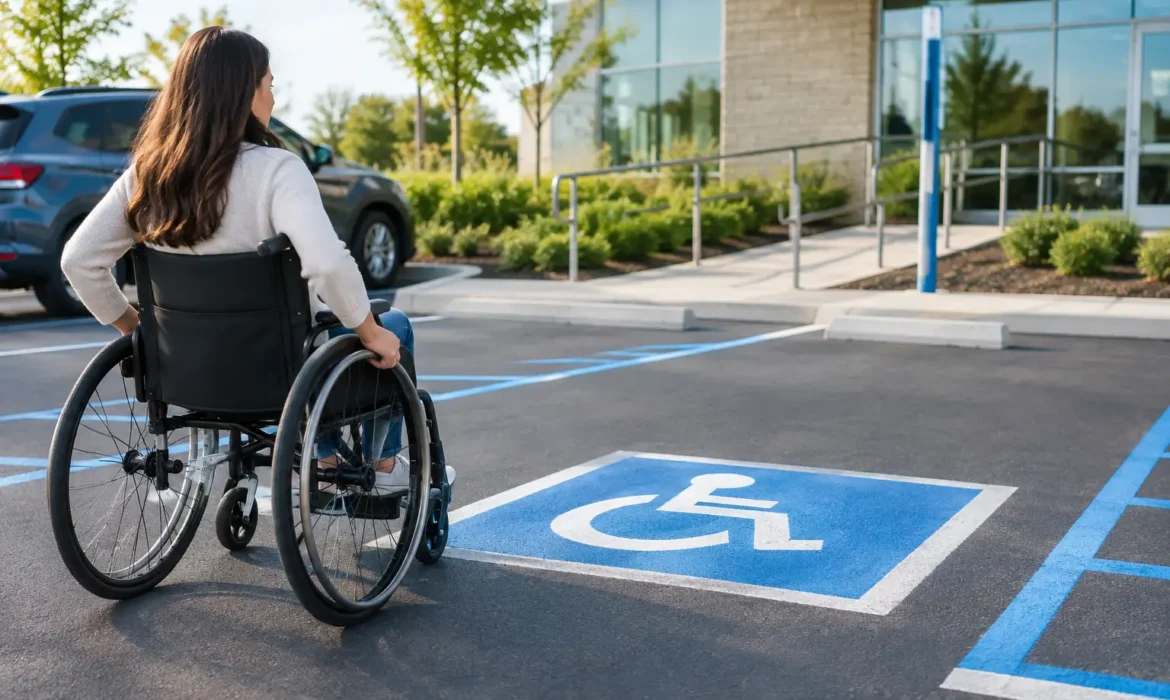
A parking lot can look freshly paved and still create a difficult arrival for customers, tenants, visitors, and employees. This parking lot accessibility guide focuses on the details that shape a person’s experience from the moment they enter the property: where they park, how they exit a vehicle, the route they take, and whether that route remains safe in changing weather.
For commercial properties, accessibility is not an isolated feature added at the end of a paving project. It is part of how the entire site works. A well-planned lot supports clear traffic flow, durable surfaces, visible markings, dependable drainage, and a direct path to the building entrance.
Start With the Full Arrival Experience
Accessibility begins before someone parks. Drivers need to understand where to enter, where to travel, where to park, and where pedestrians may be walking. Confusing traffic patterns, faded directional markings, and poorly placed barriers can create unnecessary stress before a visitor even reaches the building.
Walk the property as if you are arriving for the first time. Enter from the street, locate the accessible parking area, step out of the vehicle, and follow the route to the entrance. This simple exercise often reveals issues that are easy to miss during a drive-through inspection, such as an uneven walkway, a tight turn, a puddle at a curb ramp, or a sign blocked by landscaping.
The best layouts give people a clear, predictable route. That means separating vehicle movement from pedestrian travel where practical and avoiding situations where visitors must cross active drive lanes without obvious direction or protection.
Place Accessible Parking Where It Helps Most
An accessible parking area should do more than reserve a few spaces near the building. It should provide a useful connection between a vehicle and an entrance. Distance matters, but so does the quality of the route. A closer space is not truly convenient if a person must travel across broken asphalt, standing water, steep transitions, or a narrow walkway.
The parking surface needs to remain reasonably level and stable. Asphalt settlement, concrete heaving, and deteriorated edges can make vehicle transfers harder and create trip hazards. These conditions are especially common near drain structures, along curb lines, and in older lots where water has repeatedly entered cracks.
Space markings also deserve regular attention. Crisp striping helps drivers park predictably and keeps the intended access area clear. When paint fades, vehicles tend to drift over boundaries, reducing the usable room beside a parked vehicle. Re-striping is a relatively small maintenance step that can make a meaningful difference in daily usability.
Keep the Adjacent Access Area Clear
The area beside an accessible parking space is just as important as the space itself. It needs a clean, unobstructed surface that allows a person to move safely from vehicle to walkway. Avoid placing carts, dumpsters, temporary signs, snow piles, landscape materials, or maintenance equipment where they interfere with this area.
Property managers should also watch for gradual encroachment. A trash enclosure that was moved a few feet, a new planter, or a temporary storage habit can reduce usable space without anyone realizing the impact until a visitor has difficulty getting through.
Build a Continuous Route to the Entrance
A parking lot accessibility guide must pay close attention to the path between parking and the building. The route should feel continuous, not pieced together from disconnected sections of pavement. People should not have to navigate abrupt asphalt-to-concrete changes, loose gravel, cracked joints, or improvised detours around curbs.
Concrete walkways are often the best choice for heavily used pedestrian routes because they provide a defined, durable surface. Asphalt paths can also work well when properly installed and maintained. The right material depends on site conditions, expected traffic, drainage patterns, appearance goals, and how the route connects to existing surfaces.
Transitions are where many projects succeed or fail. A new walkway may be smooth on its own but still create a problem if it meets an older surface with a raised edge. Careful grading and finishing help keep these connections gradual, stable, and easy to travel.
Give Ramps and Curb Transitions Proper Attention
Where a pedestrian route meets a change in elevation, the transition should be intentional and professionally constructed. A properly planned ramp or curb transition provides a gradual path rather than forcing visitors to step up, step down, or roll over a sharp edge.
Drainage is especially important in these locations. Water flowing across a ramp can freeze in winter, carry debris into the travel path, or leave slick areas after heavy rain. The surface should direct water away without creating channels that are difficult to cross.
On Maryland properties, freeze-thaw cycles can be hard on concrete and asphalt. Small cracks allow water to enter, and repeated freezing can widen those openings over time. Prompt repairs protect the surface and help prevent a minor defect from becoming a larger safety concern.
Use Markings, Signs, and Curbs to Clarify the Site
A well-maintained parking lot communicates clearly. Pavement markings, directional arrows, stop bars, pedestrian crossings, curbs, and signs should work together rather than compete for attention. When these features are faded or inconsistent, visitors may hesitate, take the wrong path, or park where they should not.
Contrast matters. A visible marking is easier to identify in low light, rain, and busy conditions. This is particularly valuable near entrances, crossings, loading areas, and parking spaces designated for accessibility. High-quality pavement marking also helps property staff manage the lot more efficiently by making intended boundaries obvious.
Curbs can guide traffic and protect landscaped areas, but they should not create surprises along pedestrian routes. Damaged curbs, crumbling concrete, and irregular edges should be repaired before they become tripping points. If a curb is part of a transition area, its shape and condition deserve even closer review.
Drainage Is an Accessibility Issue, Not Just a Paving Issue
Standing water changes how people use a parking lot. A shallow puddle may seem minor from a vehicle, yet it can force a pedestrian into traffic, conceal a surface defect, or become ice during colder weather. Drainage problems also shorten the life of asphalt and concrete by allowing water to work beneath the surface.
Look for water that collects near parking spaces, walkways, ramps, building entrances, and drive lanes. Stains, cracking, surface depressions, and loose aggregate are common signs that water is not moving as intended. The solution may involve surface repairs, improved grading, drainage structure adjustments, or replacement of a failed section. The right approach depends on the source of the water, not just where it appears.
Routine cleaning matters as well. Leaves, gravel, mulch, and trash can block drainage points or make a walking surface slippery. Regular sweeping keeps the property looking cared for while helping pavement and drainage features perform as designed.
Maintain the Lot Before Small Defects Spread
Accessibility is ongoing work. Even a well-built lot needs inspection and maintenance as traffic, weather, and time take their toll. A practical seasonal review can catch problems early: fading markings, cracks, potholes, uneven joints, damaged curbs, blocked drains, and loose wheel stops.
For asphalt lots, crack filling and sealcoating can help protect the surface from moisture and oxidation when performed at the right time. Sealcoating is not a repair for structural failure, but it is a valuable maintenance step for pavement that remains fundamentally sound. Areas with deep settlement, widespread cracking, or recurring potholes may need more substantial repair to restore a stable surface.
Concrete requires its own attention. Joint deterioration, spalling, settlement, and surface scaling should be evaluated before they affect walking routes. Targeted concrete replacement is often more effective than repeatedly patching a section that continues to move or break down.
Plan Accessibility Into Every Improvement Project
Parking lot repairs, resurfacing, walkway replacement, and entrance renovations are ideal opportunities to improve accessibility. Instead of treating each repair as a separate task, consider how it affects the whole property. Repaving a drive lane may be the right time to correct drainage. Replacing a walkway may be the right time to improve a difficult transition. Re-striping may reveal that traffic flow is no longer serving the property’s current needs.
A professional site review can help prioritize work based on safety, condition, traffic volume, and long-term durability. Some properties need a focused repair. Others benefit more from a phased plan that addresses the most urgent concerns first while preparing for future improvements.
The goal is simple: every visitor should be able to arrive, park, travel to the entrance, and leave with confidence. When a parking lot is maintained with that experience in mind, it protects the property, supports the people who use it, and reflects the care behind the business or community it serves.